


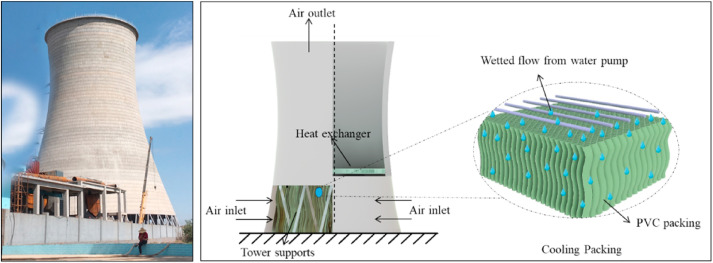
In the vast and complex world of industrial thermodynamics and HVAC systems, cooling towers stand as the sentinels of heat rejection. They are responsible for cooling water generated from industrial processes, power generation, and air conditioning systems. While the massive concrete or fiberglass structure of a tower is what captures the eye, the true “magic” of evaporation and heat transfer happens deep inside the unit.
At the core of this process lies a component often overlooked but vital for performance: cooling tower packing. Also known as “fill media” or simply “fill,” this material is the heart of the cooling tower. Without efficient packing, a cooling tower is merely a hollow box moving air over water with little thermal result.
This article explores what cooling tower packing is, the different types available, its distinct advantages, and its critical applications in modern industry.
What is Cooling Tower Packing?
To understand packing, one must first understand the basic principle of a cooling tower: evaporative cooling. A cooling tower works by bringing hot water into contact with cooler air. A small portion of that water evaporates, removing latent heat and cooling the remaining water.
However, simply dumping water down a shaft while blowing air up doesn’t work efficiently because the surface area of the water is too small. This is where cooling tower packing comes into play.
The primary function of packing is to increase the surface area of the water and maximize the contact time between the air and the water. By spreading the water out over a vast surface area or breaking it into thousands of tiny droplets, the packing facilitates a much higher rate of heat transfer. It creates a labyrinth structure that forces the air and water to interact intimately, ensuring the system operates at peak thermal efficiency.
The Physics of the Fill
When water enters the tower, it is distributed over the fill. As it descends through the packing media, it encounters an updraft or crossflow of air (driven by fans). The packing ensures that the water does not plummet to the basin instantly but rather trickles, films, or splashes down slowly. This extended duration of interaction allows the air to absorb more heat, resulting in colder water returning to the system.
Types of Cooling Tower Packing
Not all cooling requirements are the same; therefore, not all packing is constructed strictly alike. Over the decades, engineers have developed two primary categories of fill, each with distinct mechanisms for increasing surface area: Splash Fill and Film Fill.
1. Splash Fill
Splash fill is the older of the two technologies but remains highly relevant in specific applications. As the name implies, the objective of splash fill is to interrupt the flow of water and cause it to splash.
- Mechanism: Splash fill consists of layers of horizontal bars or grids. As the hot water falls, it hits these bars and shatters into thousands of tiny droplets. These droplets then fall to the next layer, splashing again.
- Surface Area: The surface area is generated by the total surface of the countless water droplets suspended in the air.
- Material: Historically, this was made of wood slats. Modern splash fill is typically made of durable PVC or Polypropylene grids.
- Best Use Case: Splash fill is the preferred choice for water with poor quality. Because the water is constantly breaking apart, there are no tight flutes or narrow passageways to get clogged. It is ideal for industries where the water contains high levels of suspended solids, oils, or biological contaminants.
2. Film Fill
Film fill is the modern standard for high-efficiency cooling towers. It operates on a different principle: spreading water into a thin sheet.
- Mechanism: Film fill consists of blocks of corrugated plastic sheets (usually PVC) packed closely together. As water flows over these sheets, it spreads out into a micro-thin “film.”
- Surface Area: The surface area is generated by the plastic sheets themselves. Because the sheets are textured (corrugated), the water clings to them, maximizing exposure to the passing air.
- Design Variations:
- Cross-Corrugated: The channels are angled to induce turbulence and mix the air and water thoroughly.
- Vertical Flow: The channels are straight up and down, offering less resistance to airflow and slightly lower fouling potential.
- Best Use Case: Film fill provides the highest thermal performance per cubic foot. It is ideal for clean water applications (like HVAC or light industrial) where maximizing cooling in a small footprint is the goal.
Materials: Durability Meets Performance
The environment inside a cooling tower is harsh. It is hot, humid, and potentially corrosive. Therefore, the material of the cooling tower packing is just as important as its shape.
- PVC (Polyvinyl Chloride): This is the industry standard for film fill. It is cost-effective, durable, and fire-retardant. However, it typically has a temperature limit of around 50°C to 55°C.
- PP (Polypropylene): For industrial applications involving higher water temperatures (up to 80°C), Polypropylene is used. It is more robust and chemically resistant but generally more expensive than PVC.
- Wood: While largely phased out for new towers due to rot and biological deterioration, treated wood is still found in some heritage splash fill applications.
- Stainless Steel: Used only in extremely specialized, high-temperature, or highly corrosive environments where plastics would fail.
Key Advantages of High-Quality Packing
Investing in the correct type and quality of fill media offers substantial benefits to facility managers and engineers.
1. Enhanced Thermal Efficiency
The most direct benefit is colder water. High-efficiency film fill can facilitate a closer “approach” (the difference between the cold water temperature and the ambient wet-bulb temperature). Colder water means chillers work less, turbines run more efficiently, and production lines cool faster.
2. Energy Savings
When the packing is efficient, the cooling tower fans do not need to work as hard to achieve the desired cooling effect. Furthermore, if the fill provides colder water to a water-cooled chiller, the chiller compressor consumes significantly less electricity. A small improvement in fill performance can lead to massive reductions in the facility’s overall utility bill.
3. Reduced Footprint
Modern film fills pack a massive amount of surface area into a small volume (ranging from 150 to over 300 square meters of surface area per cubic meter of fill). This allows engineers to design smaller cooling towers that handle larger heat loads, saving valuable real estate on rooftops or plant floors.
4. Longevity and Structural Integrity
Modern PVC and PP packing are designed to resist UV degradation, rot, and chemical attack. High-quality packs are also structurally reinforced to bear the weight of the water and the buildup of minor fouling without collapsing.
Applications Across Industries
The versatility of cooling tower packing means it is utilized across a wide spectrum of sectors.
- HVAC and Commercial Buildings: Large hotels, hospitals, airports, and data centers rely on cooling towers for their air conditioning systems. Here, high-efficiency film fill is used almost exclusively because the water is generally treated and clean, and space is at a premium.
- Power Generation: Thermal power plants (coal, nuclear, geothermal) require massive amounts of cooling. These towers are enormous and often use splash fill or low-clog film fill because the cooling water is drawn from rivers or lakes and may contain sediment.
- Petrochemical and Refining: Refineries produce water contaminated with oils and chemicals. Splash fill is often the hero here, as film fill would clog rapidly in such an environment.
- Food and Beverage: Processing plants require precise temperature control. However, food processing water can contain fats and organic solids, requiring careful selection of “fouling-resistant” film fill or splash fill to prevent biological growth.
Maintenance: The Critical Factor
While packing is a passive component (it has no moving parts), it is not maintenance-free. The efficiency of cooling tower packing can be drastically reduced by:
- Scaling: Calcium carbonate deposits (limescale) can build up on the fill, blocking airflow and adding immense weight that can cause the support structure to collapse.
- Bio-fouling: Algae and bacteria love the warm, wet environment of the fill. This biological slime acts as an insulator, preventing heat transfer.
- Clogging: Dust, debris, and sediment can block the narrow flutes of film fill.
Regular water treatment and periodic inspection of the fill media are non-negotiable aspects of cooling tower operation. If the fill becomes brittle, heavily scaled, or clogged, replacement is often the most economic solution to restore system efficiency.
Conclusion
The cooling tower is a critical utility in the modern world, and the packing is arguably its most essential component. Whether utilizing the droplet-shattering power of splash fill or the surface-maximizing geometry of film fill, the goal remains the same: efficient heat rejection.
By understanding the types and applications of cooling tower packing, facility managers can ensure their systems run cooler, last longer, and consume less energy. As industries push for greater sustainability, the humble fill media will continue to evolve, driving the future of evaporative cooling technology.